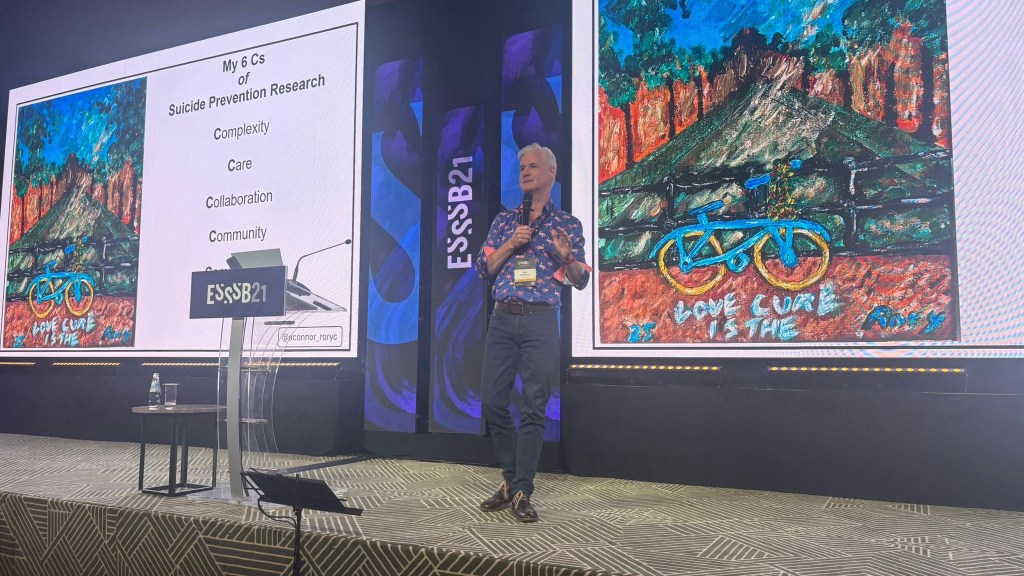
I had the great honour of being asked to close the 21st European Symposium on Suicide and Suicidal Behaviour in Vilnius, Lithuania, with some personal reflections. To do so, I structured them around what I described as my 6Cs of suicide prevention research: Complexity, Care, Collaboration, Community, Compassion and Connection (which built upon my 4Cs of suicide prevention).
So before I forget, here is what I tried to convey, with a little more context.
Complexity
Suicide prevention research is complex. Suicide risk is not static; it is dynamic, changing over time and in response to our life circumstances. Although globally we have made progress in reducing suicide over the past 30 years, rates are rising in too many countries. And global progress offers little comfort to those of us who have been bereaved by suicide. Especially as more than 720,000 people die by suicide each year, with about three quarters of these losses occurring in low- and middle-income countries.
Suicide prevention, therefore, demands urgent action and it must be treated seriously as a global public health concern. It requires many different approaches, including qualitative and quantitative research; for example, it requires us to understand how suicide risk fluctuates in daily life, as well as benefiting from the insights from big data, together with listening to people’s stories; it spans history, biology, psychology and sociology and so much more.
It also requires us to understand the wider political and cultural contexts in which people live, including the inequalities and intersectional disadvantages that can contribute to suicide risk.
Although suicidal thoughts and behaviours are experienced by individuals, to understand and prevent them we need to also recognise the interpersonal, community and societal influences that shape our lives.
And, of course, our research and suicide prevention efforts need to have human rights at their heart.
Care
We need to reflect on our models of care and ask what kind of treatment or care a person needs when they are in crisis. Moreover, too many people cannot access evidence-based care when they need it, and too often what’s available is not tailored to their needs, and is insufficiently relational in its focus. There is no one-size fits all.
Moreover, although we have evidence-based psychological treatments, we need to know much more about who they work for, when they have the best chance of success, and what the active ingredients are. Implementation science should always be integral to all of our suicide prevention efforts. We also need more research into the role of the therapeutic alliance in treatment success.
Of course clinical care is vitally important. But given that the majority of people who die by suicide are not in touch with mental health services, we also need to broaden how we conceptualise care and wider support. We need to consider what else we can do to help workplaces, schools, communities and wider society to tackle stigma, to provide support, not only when we are struggling.
For too many people, life is unbearably painful. And this pain is often hidden. Our task is not simply to ask how we prevent someone from dying, but how can we help make life more liveable. How can we reduce the pain and sense of entrapment that can make it difficult to see another way forward? To this end, there is so much we can learn from Indigenous communities from across the world, harnessing their thousands of years of wisdom and knowledge.
Collaboration
Suicide prevention needs all of our talents, across disciplines, professions, backgrounds and experiences. Only through genuine collaboration will we be able to tackle suicide with the urgency and combined expertise that we need. And collaboration requires trust and safety.
Working together across disciplines and perspectives also requires us to be open to other viewpoints: to ask how approaches that are different from our own might help us to understand something that we otherwise might miss.
It requires humility, to recognise that none of us has all of the answers or is the custodian of some universal truth.
And collaboration cannot simply mean inviting people into conversations on terms that have already been decided by others. Everyone’s voice needs to be heard and treated with equal respect, especially when we disagree.
Community
The suicide prevention research community is a special and precious one. For me, it is like a family which provides strength, challenge and support. It brings together researchers, clinicians, people with lived and living experience, policy-makers and many others besides.
We need to continue to build and nurture this community, because it is one of our greatest strengths. But community is more than bringing people together. It is about creating a sense of belonging and shared purpose, while making space for different experiences, perspectives and voices.
Suicide prevention research must be shaped by, co-produced with, and ultimately serve the people and communities whose lives we hope it will improve.
Compassion
Too often, people who are suicidal are not treated with the dignity, humanity and respect they deserve. This has to change. Compassion must be at the heart of our research, our services and every encounter with someone who is struggling.
Compassion is not optional. It is fundamental to all suicide prevention efforts.
We also need to show compassion towards everyone working in suicide prevention. This work matters so much, but it can also take its toll on us working day-in and day-out in the field. The emotional burden can be immense.
As a result, we need to extend that same compassion to ourselves. Looking after ourselves and one another is not distinct from our work; it is what allows us to sustain it. We must always give ourselves the time, space and compassion for self-care.
Connection
The complexity of suicide prevention research can feel overwhelming. But amid that complexity, we should not lose sight of something deeply human: connection really matters.
Sometimes seemingly small acts of connection can help us to feel less alone, less isolated and more connected to life. They can challenge the painful belief that we do not belong, or that we are a burden on those around us.
So, we need more research into what creates and sustains meaningful connection, how we strengthen our sense of belonging, and how we ensure that people have somewhere, and someone, to turn to when life becomes difficult.
Final thoughts
Suicide prevention is difficult because suicide is complex. There will never be a single intervention, one discipline or one answer. But Complexity should not become an excuse for inaction. The time for action is now.
We can provide better Care. We can Collaborate more generously. We can strengthen our Community. We can put Compassion at the centre of what we do. We can create Connection where there is isolation. And we can remain open to recognise what we still do not know, and whose voices we still must hear.
Perhaps, ultimately, these Cs suggest one further overarching C, Commitment: to try to understand more, to strive to care better, and to do everything we can to help make more lives feel liveable.
Rory O’Connor, PhD FRSE FAcSS, Director, Suicidal Behaviour Research Lab
Disclaimer: These are my quick reflections, I will undoubtedly have missed important points.
PS. What’s the story with the painting behind me in photo above? I was inspired by a bridge in Amsterdam which reminded us that Love is The Cure. So, I felt compelled to paint it, as it resonated with me and with our efforts in suicide prevention.
 Suicidal Behaviour Research Laboratory
One thought on “My 6Cs of Suicide Prevention Research”
Comments are closed.