Have you ever felt lonely, but not wanted to reach out to someone? It can happen in a crowded room, or when you are alone with a phone full of contacts and messages. Despite being seemingly more connected than ever, loneliness remains incredibly common and many of us find social connections challenging. Furthermore, the research on loneliness is clear: temporary feelings of loneliness are normal, helpful even. But when it becomes persistent, loneliness can lead to suicidal thoughts and behaviours (McClelland et al. 2020).
What is loneliness and how can we respond to it when we experience it?
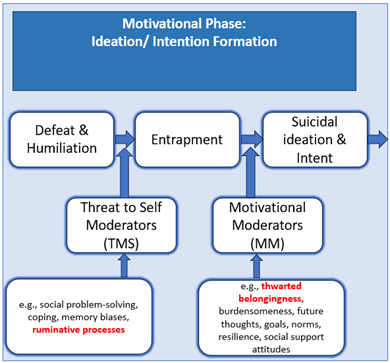
Loneliness is the subjective feeling that the quality, or quantity, of our social connections is deficient in some way (Perlman & Peplau, 1981). It is often invisible to others and therefore it is easy to go unnoticed. As illustrated by our research, in the context of the Integrated Motivational Volitional (IMV) model of suicidal behaviour, loneliness is largely associated with thwarted belongingness as a Motivational Moderator. However, another key feature of both loneliness and suicidal ideation is ‘rumination’ – the repetitive thinking about a topic – which can be cyclical and has been largely associated with both depression and anxiety (Zawadzki et al., 2013). Therefore, spending long periods of time thinking about being lonely, or lack of social connectivity, can adversely impact psychological wellbeing in a variety of ways (see figure 1).
Figure 1. The Motivational Phase of the Integrated Motivational Volitional Model
Responding to loneliness
Anti-stigma campaigns consistently show that talking about adverse experiences can help improve understanding and awareness of ‘taboo’ subjects, such as suicide or loneliness (Song et al. 2023) . However, sometimes connection doesn’t start with talking—it starts with doing. Although it can be difficult, being around others with a shared interest can foster a sense of inclusion (Haslam et al., 2016). Over time, those small moments may turn into meaningful relationships, which can be protective from suicidal distress.
Creating opportunities for social connection is a key step for reducing loneliness and increasing friendships. This involves not just trying something new (e.g., striking-up a conversation, joining an in-person or online special interest group), but also giving social connections time to grow through consistency and perseverance. However, in many cases for those who are struggling with connections this is easier said than done.
Acceptance and Commitment Therapy (ACT) is a values-based model, derived from cognitive behaviour therapy. The model encourages individuals to pursue their personal goals via their ‘commitment to action’, despite potentially experiencing difficult thoughts or feelings. Although originally designed for chronic conditions such as depression, it is also applicable to other forms of discomfort such as loneliness or suicidal ideation. The essence of this approach is to reduce the individual’s avoidance of distressing thoughts (e.g., ruminative thoughts of loneliness or suicidal distress) and positively reframe these thoughts and feelings and to commit to more positive behaviour to reduce their distress.
Acknowledging lonelinessAn alternative way to respond to loneliness is to acknowledge it, then try to do something which may help, no matter how small! For example, Gilbody and colleagues found that behavioural activation significantly reduced loneliness and depression among isolated adults. Behavioural activation refers to noticing how behaviour can affect mood, for example scheduling activities that promotes enjoyment or a sense of accomplishment. This is consistent with the IMV model, whereby ‘goals’ (a Motivational Moderator) can influence suicidal thoughts. Not only does striving towards positive goals increase a sense of fulfilment, but the activity also distracts from the feelings of loneliness (Klug & Maier, 2015; Gilbody et al., 2011). Therefore, pushing yourself out of your ‘comfort zone’ to do something, with or without people, may help you feel better:
Wanting to go watch the football but no one was free?
Why not go anyway? Between the game and the chanting, you might really enjoy yourself.
Want to go for a coffee but got no one to talk to?
Why not order your favourite coffee and listen to a podcast to hear what someone else has to say.

Take control
Feeling valued and seen really matters (McComb et al., 2020). Research indicates that establishing, or improving, social connection is dependent on having a reciprocal relationship with someone else. Therefore, instead of waiting for someone to reach out to you, why not reach out to them? Even a brief message is a good place to start, or calling someone to ask how they are doing, can be enough to ease brief feelings of psychological discomfort. The same is true for suicidal distress. Suicide prevention safety plans include two options for listing friends and family. One is a list of contacts to disclose the distress to, the other is to think about someone you could go to for distraction (without necessarily telling them about your suicidal thoughts). Such brief contacts can be enough to get the ball rolling for a more meaningful conversation, perhaps even to make plans to meet at a later date (i.e., goal setting).
How to build meaningful relationships
Loneliness is multifaceted (Walsh et al., 2025), so it can help to avoid being over-reliant on one individual or group to relieve feelings of loneliness. Although this does not apply to everyone, for many people, membership of multiple networks can be helpful (e.g., personal friends, workplace communities, online groups).
Research has also shown that people who engage in activities they enjoy, are more likely to make meaningful, lasting relationships and report greater life satisfaction. For loneliness this is critical, as loneliness is often only truly relieved once meaningful connections are made – and this takes time. Friendships are often developed through shared experiences, not just coincidental interests.


However, these hobbies or habits do not need to be ‘big’ or include deep conversations. ‘Granny Core’ (i.e., real-world, tactile activities – commonly associated with ones grandparents’ generation) has become extremely popular among young adults, with its essence being to engage in quiet hobbies which can – but not necessarily – involve other people (e.g., cross-stitching, baking, birdwatching). Regardless of the hobby, through engagement people can develop skills, curiosity, and opportunity for shared interests, which can lead to social connections. These social connections can lead to feelings of social support, positive goals and distraction from ruminative processes, influencing factors in the development of suicidal thoughts.
Conclusion
In summary, many people experience loneliness, but when it becomes persistent it can be strongly linked with symptoms of anxiety, depression and suicidal distress. Forming social connections is important for wellbeing and does not need to be ‘big’ or all encompassing. The important thing is to try to show up for the things that matter to you. Social connection can grow from there.
Dr Heather McClelland is a Lecturer in the Doctorate in Clinical Psychology Programme at The University of Glasgow. She finished her PhD in 2022 focussing on loneliness and suicide risk.
 Suicidal Behaviour Research Laboratory
You must be logged in to post a comment.