
Below are some mental health tools and resources which may be useful when working with people who are suicidal and/or in distress.
- IMV Suicide Risk Formulation Form (ISRFF)
- Recognising and Responding to Distress (RR2D – free training)
- Distress Management Plan (D-MaP)
- Safety Plan
- The Entrapment Scale-Short Form
- A Psychological Approach to Understanding & Preventing Suicide (Free training modules)
The IMV Suicide Risk Formulation Form (ISRFF)
The IMV Suicide Risk Formulation Form (ISRFF – beta version) is a tool to help mental health professionals incorporate the main components of the IMV model into a suicide risk formulation. The form is freely available below together with brief guidance notes to aid its implementation in clinical practice.

Recognising and Responding to Distress (RR2D)
Recognising and Responding to Distress (RR2D) is a learning e-module which aims to empower individuals to provide a compassionate and effective response to people experiencing distress.
The module is designed to be suitable for people from a variety of different organisations and in a wide range of roles who may respond directly to people experiencing distress.
For further information on the module and how to access it, please see the course descriptor sheet.
The Distress Management Plan (D-MaP)
The Distress Management Plan (D-MaP) is a resource we developed as part of the Distress Brief Intervention (www.dbi.scot) and the Recognising & Responding to Distress Module to help someone experiencing distress begin to explore and make sense of their distress.
The D-MaP will help the person identify what led to their distress, problem-solve key issues, and identify strategies to manage their distress.
These guidance notes will help you understand the D-MaP so that you feel prepared to introduce the D-MaP to someone in distress.
SBRL Safety Plan
Safety planning is a brief structured intervention which helps identify warning signs that a suicidal crisis might be escalating as well as techniques to keep someone at risk of suicide safe.
The safety plan that we use in SBRL is based on Stanley, Brown et al. (2018) which we trialled in our recent SAFETEL study (O’Connor et al., 2022).
If you are supporting someone and they tell you that they are thinking about harming themselves then it may be appropriate to co-develop a safety plan to help them keep safe. The accompanying guidance notes will help you understand how to co-develop the safety plan.
The Entrapment Scale-Short Form
Entrapment, an important driver for suicidal behaviour, is usually assessed with the 16 item entrapment scale (Gilbert & Allan, 1998).
We developed a 4 item short form of the 16 item entrapment scale using data from both clinical and population samples.
The short form resulted in nearly identical results as the 16-item full scale.
We suggest using the 4 item short form to assess and monitor entrapment in clinical and research settings.
De Beurs, D., Cleare, S., Wetherall, K., Eschle-Byrne, S., Ferguson, E., O’Connor, D.B., & O’Connor, R.C. (2020). Entrapment and suicide risk: the development of the 4-item Entrapment Scale Short-Form (E-SF). Psychiatry Research, 284, 112765.
A Psychological Approach to Understanding & Preventing Suicide (Free training modules)
We have developed a suite of learning modules on A Psychological Approach to Understanding and Preventing Suicide, funded by and in partnership with NHS Education Scotland. The aim of these modules is to get to the heart of this most tragic of human outcomes, challenging myths and misunderstandings about suicide by bringing together people’s stories with the research evidence.
It is hoped that the modules will provide learners with the knowledge and resources to empower and enable them to respond compassionately to people who are suicidal. The modules aim to improve the understanding of the complex set of factors that lead to suicide, to provide a framework to make sense of suicide and an overview of the evidence of what works to prevent suicide. Throughout the modules, the importance of viewing suicide as a psychological phenomenon but driven by a diverse range of factors will be highlighted.
Authors: Professor Rory O’Connor & Dr Karen Wetherall
The modules are organised into 4 free modules. The learning outcomes and links to each module are found below. The modules are free, so please share the details with anyone who may be interested. To access the module(s), just register or sign in with TURAS (https://turasdashboard.nes.nhs.scot/).
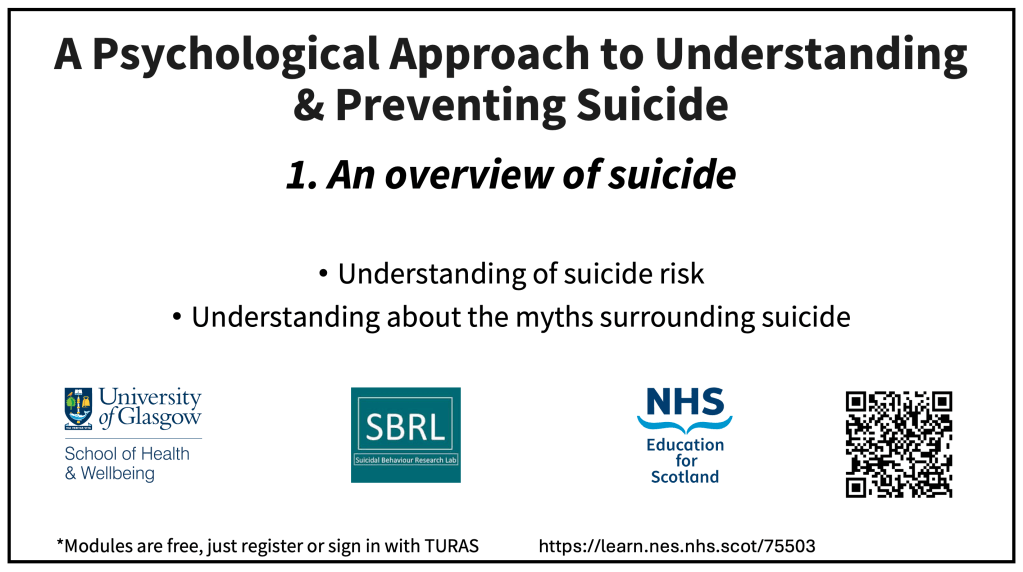
This module fits within the Informed Level of the
Mental Health Improvement & Suicide Prevention Framework
*Module is free, just register or sign in with TURAS (https://turasdashboard.nes.nhs.scot/).
To access this free module (module 1): https://learn.nes.nhs.scot/75503
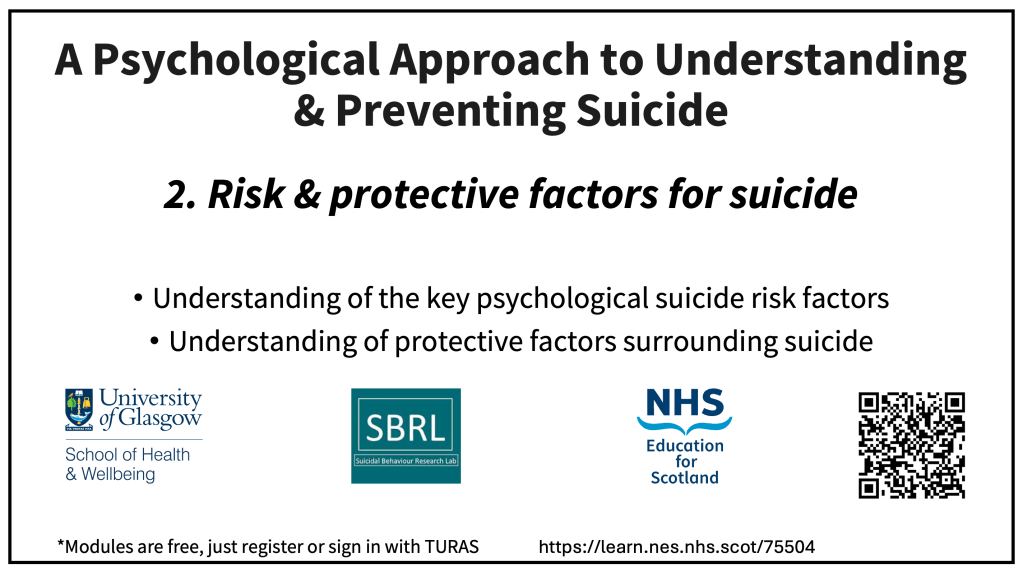
This module fits within the Skilled Level of the
Mental Health Improvement & Suicide Prevention Framework
*Module is free, just register or sign in with TURAS (https://turasdashboard.nes.nhs.scot/).
To access this free module (module 2): https://learn.nes.nhs.scot/75504
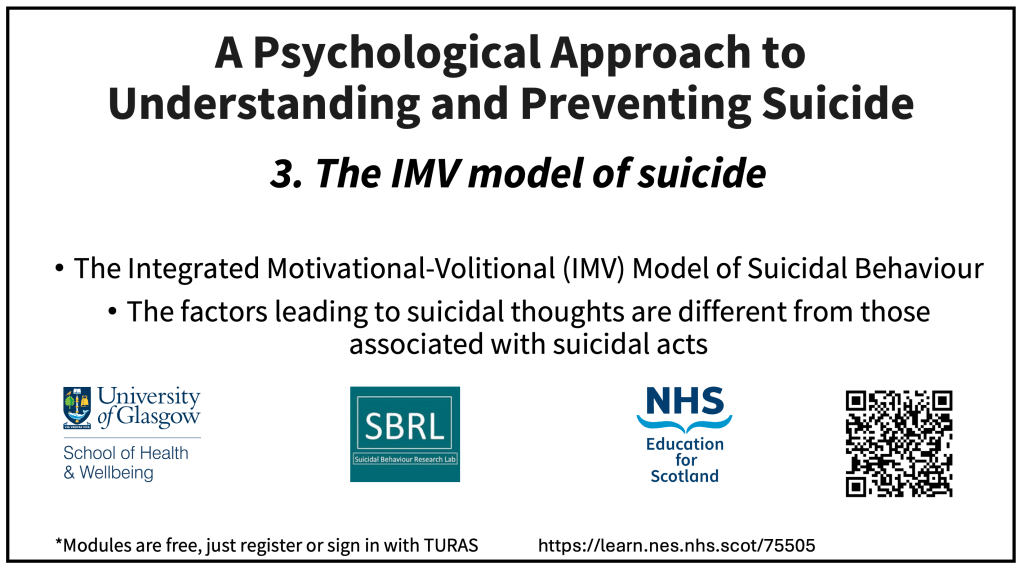
This module fits within the Enhanced Level of the
Mental Health Improvement & Suicide Prevention Framework
*Module is free, just register or sign in with TURAS (https://turasdashboard.nes.nhs.scot/).
To access this free module (module 3) :https://learn.nes.nhs.scot/75505
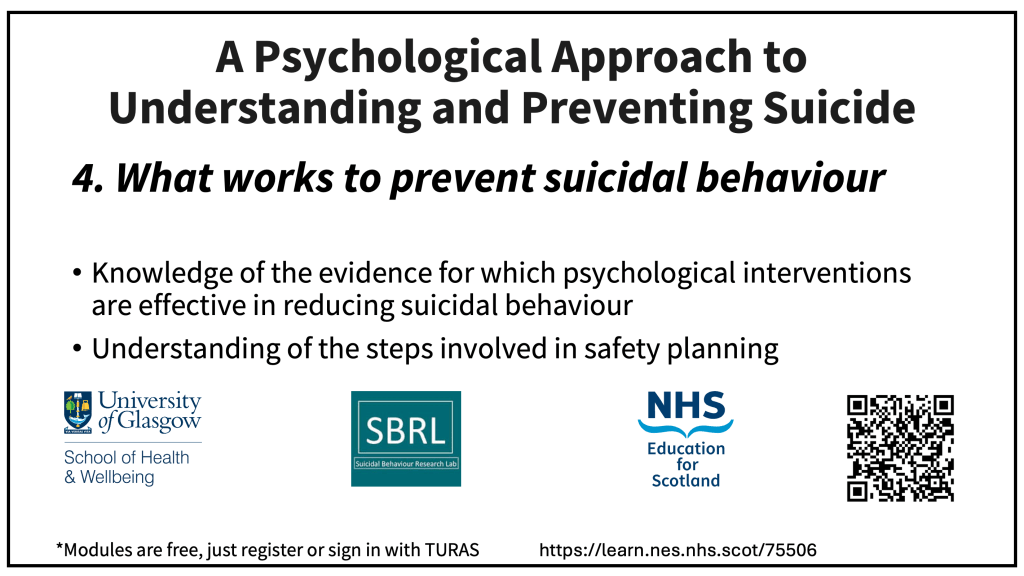
This module fits within the Enhanced Level of the
Mental Health Improvement & Suicide Prevention Framework with overlaps with other levels
*Module is free, just register or sign in with TURAS (https://turasdashboard.nes.nhs.scot/).
To access this free module (module 4): https://learn.nes.nhs.scot/75506
 Suicidal Behaviour Research Laboratory
You must be logged in to post a comment.