“Please don’t do anything stupid”, a well-intended comment made by many who are concerned for an individual’s welfare. But how helpful is it? This quote highlights how embedded into society suicide-related stigma is, reducing the complexity of a suicidal act to a single word: “stupid”. Some also describe suicide as “the cowards way out”, and even more embedded within society is the terminology “committed suicide”. The term ‘committed’ should be avoided as it suggests that a crime of some kind has taken place, likely due to the fact that suicide was a crime in the UK until 1961. Today, suicide is still a criminal offence in 25 countries across the globe with punishments ranging from fines to jail time. In recent years there have been important developments regarding the language used around suicide, with a shift towards using less stigmatising phrases such as “died by suicide”.
Stigma is described as a mark of disgrace associated with a person, personal quality or a personal circumstance; it is often a strong opinion of disapproval that some people in society hold about something. Stigma creates feelings of devaluation by ensuring that “us” vs “them” groups are present within society. Stigmatisation leads to individuals being excluded and isolated which not only influences their status within society, but can also impact their views of themselves, contributing to lowered self-esteem and feelings of unworthiness. Historically, many groups of people have been subject to stigma such as divorcees and single mothers. Still relevant today is the stigmatisation of members of the LGBTQ+ population, those experiencing mental health concerns, and those who have experienced suicidal thoughts, attempts or bereavement by suicide, among others.
Suicide-related stigma refers to the stigma attached to those who die by suicide, those who experience suicidal thoughts, those who have attempted suicide and those bereaved by suicide. Research has highlighted that the stigmatising attitudes attached to those with experiences of suicide include that they are “selfish”, “weak”, “attention-seeking” and “stupid”. But what are the consequences of such attitudes? As highlighted earlier, stigma can lead to feelings of shame and exclusion, and those experiencing suicidality often keep it secret as a result of stigma which puts them at a greater risk of suicide. For example, in a recent study that we conducted participants expressed their desire to keep their experiences of suicide a secret: “I didn’t even want to say the word” (Wyllie et al., in preparation).
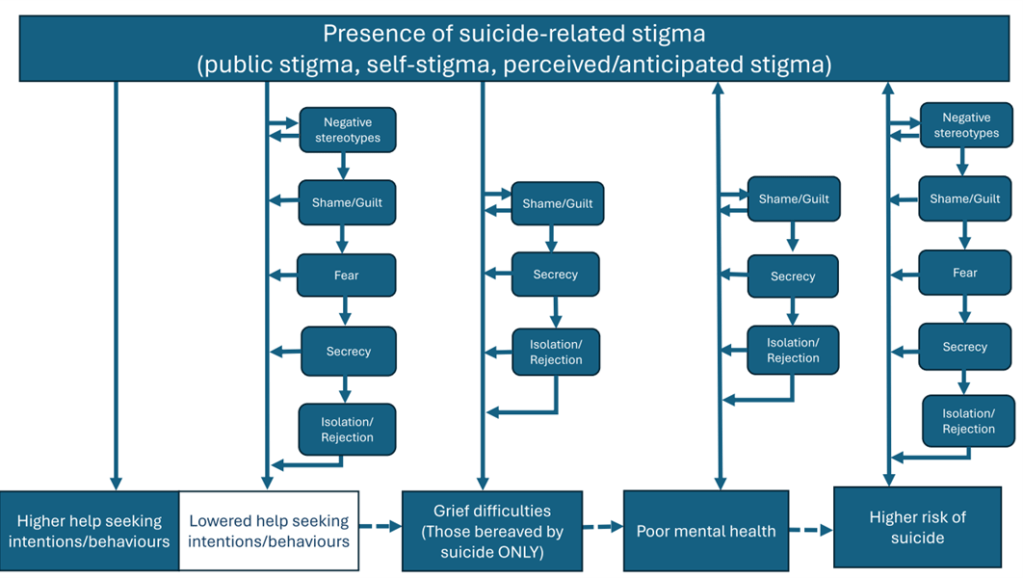
We have also conducted a scoping review (of qualitative and quantitative studies) which investigated the associations between suicide-related stigma and four variables: mental health, help-seeking, grief, and suicide risk. The review published in BJPsychOpen found that across 100 papers, suicide-related stigma led to predominantly negative consequences. Figure 1 below displays the associations between these variables and suicide-related stigma, the arrows express the direction of the relationship. Overall, suicide-related stigma appears to lead to lower intentions to seek help and greater grief-related difficulties among those bereaved by suicide. However, in some studies, suicide-related stigma led to an increase in help-seeking behaviours. One reason for this could be the role of religious beliefs. A participant in our qualitative study said that the view that suicide was a sin prompted her to seek help: “I don’t wanna say that it’s protective because I think it’s destructive in its own right but I’d probably be dead if it weren’t for that”.
The association between suicide-related stigma and poor mental health was bi-directional, those with poor mental health were more likely to hold stigmatising attitudes towards suicide, however the stigmatisation of suicide was also more likely to lead to poor mental health. Similar results were found for suicide risk. Within the qualitative studies included in the review, several factors, such as negative stereotypes, shame/guilt, fear, secrecy and isolation/rejection were reported as reasons why suicide-related stigma led to lowered help-seeking intentions/behaviours, grief difficulties (among those bereaved by suicide only), poor mental health and higher suicide risk. Furthermore, the four variables displayed at the bottom of Figure 1 (help-seeking, grief, mental health and suicide) all have dotted arrows connecting them as although not evidenced within our review, each of these variables is known to negatively affect one another. For example, lowered help-seeking has been shown previously to lead to grief related difficulties which have been shown to lead to poor mental health and poor mental health is, in turn, a risk factor for suicide.
Figure 1. A pathway model of suicide-related stigma (from Wyllie et al., 2025).
So, to answer the question posed at the beginning of this blog, how helpful are phrases such as “Please don’t do anything stupid”? The evidence is clear, they are not helpful as they reinforce the stigma around suicide which may do more harm than good.
 Suicidal Behaviour Research Laboratory
You must be logged in to post a comment.